
Common Clash Detection Mistakes In Existing Buildings And How To Prevent Them
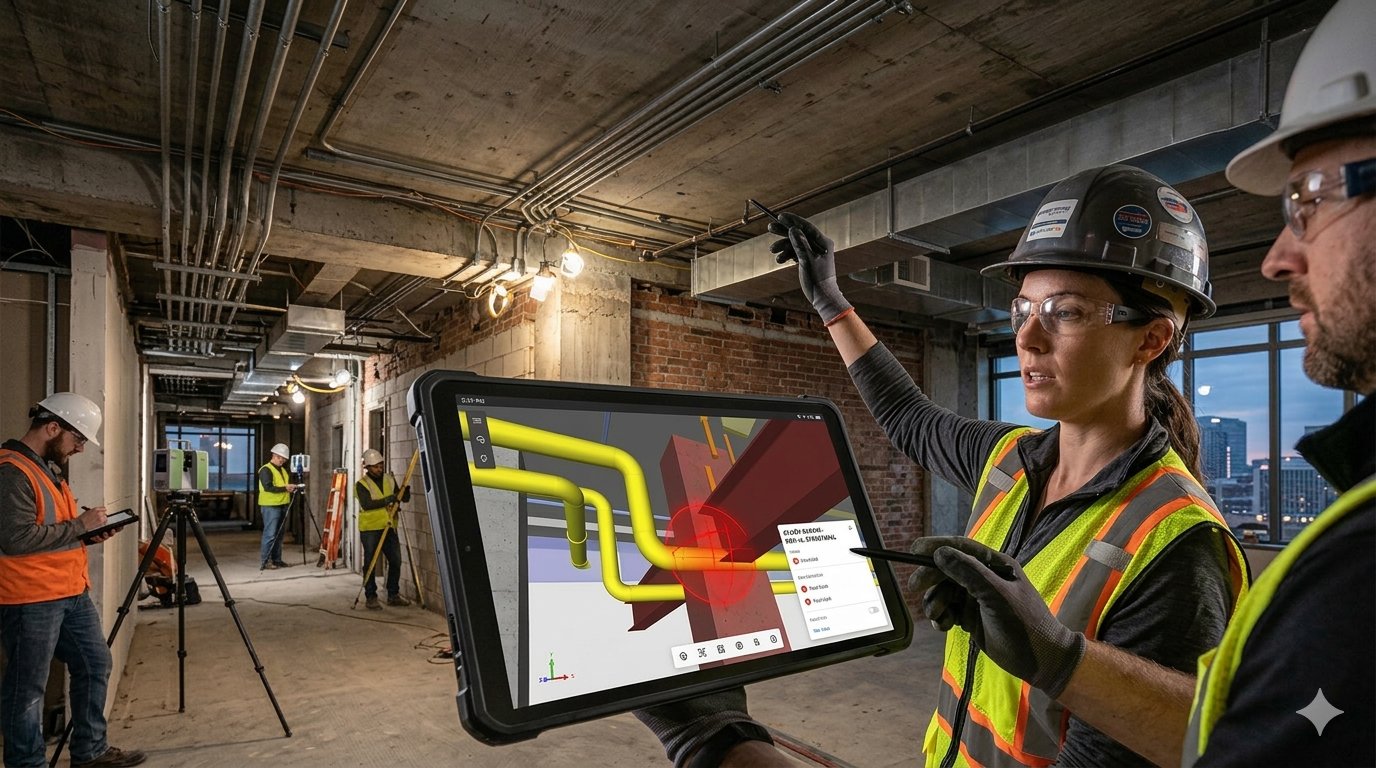
Clash detection in existing building retrofit projects depends on accurate as-built geometry, validated point cloud data, discipline-specific tolerance configuration, and controlled coordination workflows. In renovation environments where live MEP systems, undocumented rerouting, and spatial constraints define project risk, unresolved conflicts can consume 4-6% of total project value through fabrication revisions, demolition adjustments, and installation resequencing. This article details the most critical technical mistakes in retrofit coordination and presents structured, scan-validated, rule-based methods that BIM professionals can apply to reduce rework exposure, stabilize model accuracy, and improve constructability outcomes before construction mobilization.
Why Clash Detection Fails More Often in Existing Buildings
Collision detection operates predictably in new construction because geometry, sequencing, and system routing are defined before installation. In existing buildings, coordination begins with inherited conditions that include layered trade modifications, shifted structural members, undocumented service rerouting, and partial legacy documentation. Autodesk construction industry data shows that rework is associated with coordination, and in MEP-intensive retrofit projects this exposure increases once demolition adjustments, prefabrication changes, labor remobilization, and recovery scheduling are factored into cost planning.
Retrofit environments introduce physical and operational constraints that directly influence coordination reliability. Digital models must account for real-world spatial compression, operational continuity, and restricted access conditions that are not present in ground-up construction. These constraints demand higher model precision and structured validation before fabrication release or site mobilization.
Key retrofit constraints that increase coordination risk include:
- Live mechanical, electrical, and plumbing systems remaining operational
- Ceiling voids and riser shafts with limited vertical and horizontal clearance
- Short shutdown windows for tie-ins and service diversions
- Restricted access to mechanical rooms, basements, and plant areas
- Historical drawings that differ from actual field conditions
- Legacy penetrations and sleeves that no longer align with structural grids
When these constraints are introduced into a coordination workflow without validated geometry and structured rule configuration, clash detection engines produce. In existing building projects, coordination accuracy depends on model inputs that reflect actual site conditions and on disciplined workflows that control how those inputs move through the detection and resolution cycle.
Understanding The Types of Clashes in Retrofit Projects
Conflict detection in retrofit projects evaluates spatial conflicts and coordination inconsistencies within a federated BIM model before installation activities begin. In renovation work, new MEP systems must integrate within constrained structural grids, fixed slab elevations, and pre-existing service zones, which increases the density and complexity of detectable conflicts.
Types of Clashes in Retrofit Coordination:
- Hard Clashes – Direct physical intersections between elements, such as ductwork crossing structural beams, pipes penetrating slabs without sleeves, or cable trays intersecting other services.
- Soft Clashes – Clearance or access violations where required maintenance, code-mandated working space, or removal zones are not maintained around panels, valves, dampers, or equipment.
- Workflow Clashes – Sequencing, phasing, or trade coordination conflicts where installation logic, access timing, or data inconsistencies disrupt planned construction activities.
Hard clashes surface during model-based interference testing. Soft clashes often become visible during inspection, commissioning, or authority review. Workflow clashes influence scheduling, trade stacking, and site logistics. Effective retrofit coordination requires structured testing across all three categories to maintain constructability and installation sequencing integrity.
Common Clash Detection Mistakes in Existing Buildings
Modeling from Outdated or Incomplete As-Built Data
Conflict identification accuracy in retrofit projects depends on verified as-built geometry and constructible model detail. Coordination frequently begins from 2D legacy drawings, manual tape surveys, assumed grids, or partial ceiling access, while discipline models include placeholder elements, simplified routing, missing hangers, omitted fire protection, or generic equipment without clearance zones. Manual surveys introduce ±50–100 mm deviation, critical in risers and mechanical floors. Laser scanning delivers ±5–10 mm accuracy, with ±10 mm model-to-cloud validation thresholds, making MEP scan to BIM workflows essential for converting point cloud data into coordinated, fabrication-ready models. Inaccurate geometry leads to misaligned penetrations, sleeve errors, fabrication changes, RFIs, and $100K–$500K site-level conflict resolution costs.
Mistakes | Prevention |
| Using 2D legacy drawings as primary coordination reference | Capture site conditions using laser scanning before design freeze. Define LOIN/LOD for coordination. |
| Relying on manual tape surveys with ±50–100 mm deviation | Register scans to verified control points and validate alignment |
| Modeling with a placeholder or LOD 200 geometry | Define minimum LOD 300 for coordination in the BIM Execution Plan |
| Omitting hangers, supports, fire protection, or connection data | Conduct discipline-level QA to confirm geometry completeness |
| Ignoring vertical offsets and structural deviations | Perform deviation analysis between model and point cloud |
| Federating models without validation | Apply BIM workflows and enforce ±10 mm model-to-cloud tolerance checks |
Running Clash Detection Too Late in The Design Cycle
Conflict detection initiated after design development or issue-for-construction stage restricts routing flexibility because equipment selections, structural penetrations, and prefabrication strategies are already fixed. This risk is amplified in the , where existing conditions, concealed services, and phased occupancy further limit coordination flexibility. In retrofit environments, layout changes influence active systems and occupied zones, compressing redesign windows and increasing RFIs, trade escalation, and schedule compression. Late coordination shifts effort from optimization to rework, forcing redesign of sleeves, supports, and distribution paths. Iterative clash testing during schematic and design development phases reduces fabrication revisions and stabilizes installation sequencing before procurement and site mobilization begin.
Poor Clash Rule Configuration and Tolerance Settings
Default clash rules and uniform tolerance values generate excessive false positives while missing critical clearance violations. Running broad “all vs all” tests without discipline separation produces disorganized reports and overlooked structural priorities. Applying identical tolerance to ducts, cable trays, and sprinkler lines ignores installation realities. Improper rule configuration directly contributes to field-level MEP clash detection errors when clearance or structural conflicts remain undetected during coordination.
Assuming Drawings Reflect Actual Conditions
Historical documentation frequently omits rerouted services, equipment replacements, ceiling height modifications, and field-adjusted supports. Routing decisions based solely on legacy drawings introduce measurable geometric deviation into coordination models. Undocumented services remain a primary source of retrofit conflict discovery during demolition or installation. Integrating MEPF scan to BIM modeling enables accurate capture of existing mechanical, electrical, plumbing, and fire protection systems, reducing geometric discrepancies and minimizing unforeseen coordination conflicts during renovation and retrofit projects.
Conclusion
Clash detection in retrofit projects performs effectively when coordination inputs are measurable and controlled. Scan-validated geometry, defined LOD 300–350 standards, calibrated structural and MEP tolerance matrices, and modeled supports establish a stable coordination baseline. In service-dense risers and ceiling voids with limited vertical clearance, maintaining ±10 mm validation thresholds protects routing feasibility and penetration accuracy. Phased clash cycles before equipment and sleeve release support constructability alignment prior to fabrication.
Retrofit environments operate within active systems, fixed structural grids, and constrained shutdown windows. Early coordination directly influences fabrication sequencing, access clearance compliance, and installation logic. Structured clash ownership, version-controlled federation, and targeted scanning of high-density zones maintain model reliability. When coordination is grounded in verified site conditions, conflict resolution remains within the digital environment, preserving schedule stability and budget performance.









0 Comments